
AI Governance
Operating Environment
Manage and govern your AI portfolio with confidence. From inventory to compliance, built for organisations navigating the global AI laws and responsible AI practices.
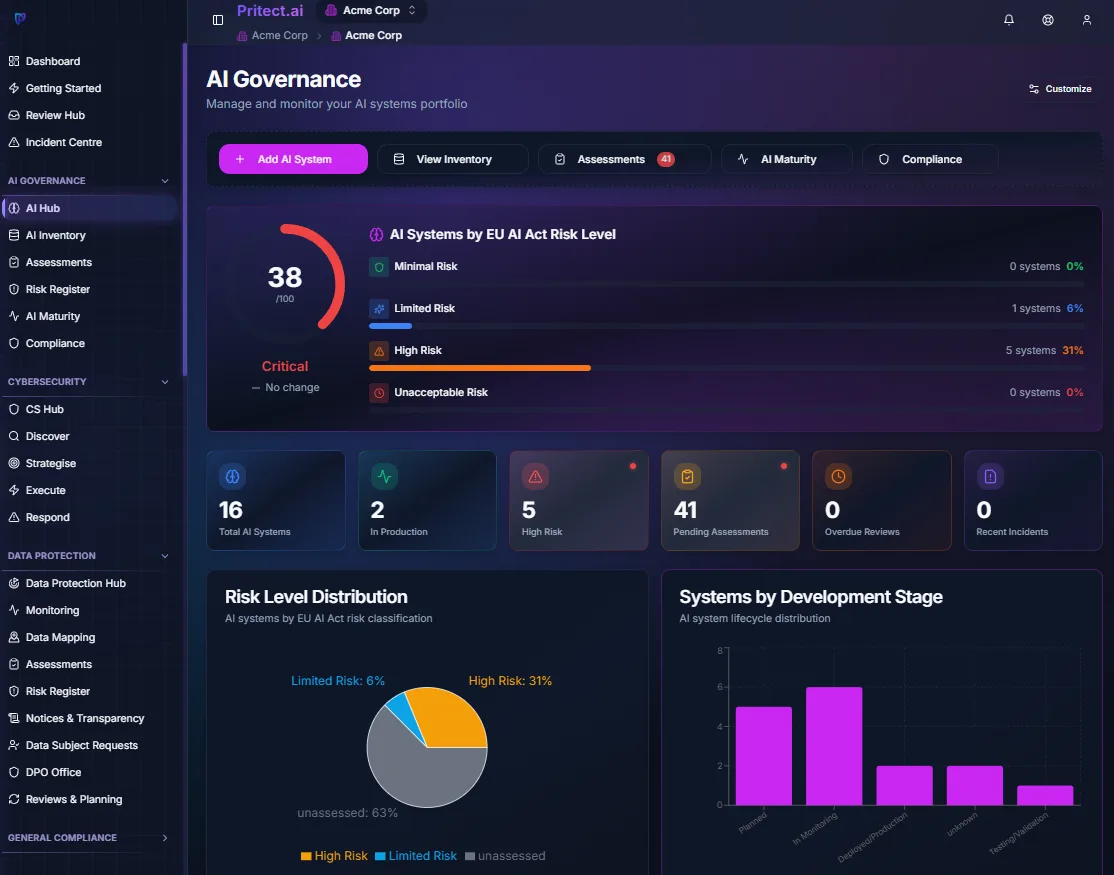
Four Pillars of AI Governance
From building your AI inventory to managing incidents, Pritect enables comprehensive AI governance for organisations in the AI era.
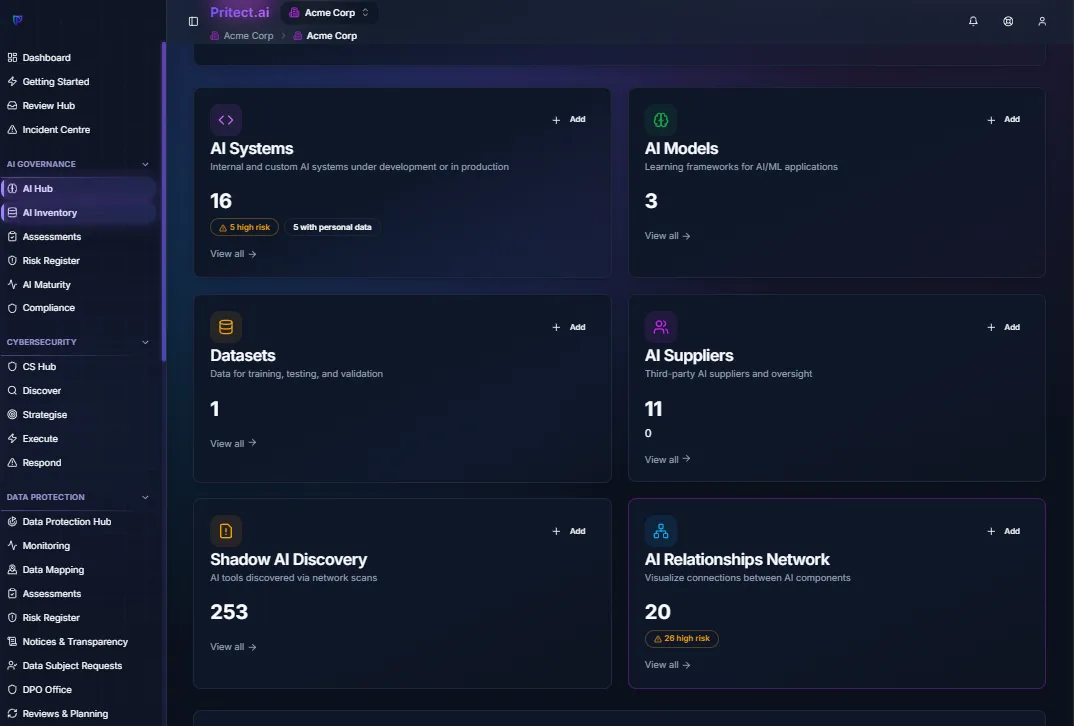
Inventory
Know your AI landscape
Build complete visibility into AI systems, models, datasets, and suppliers across your organisation.
- AI System Registry
- Model Catalogue
- Dataset Management
- AI Supplier Tracking
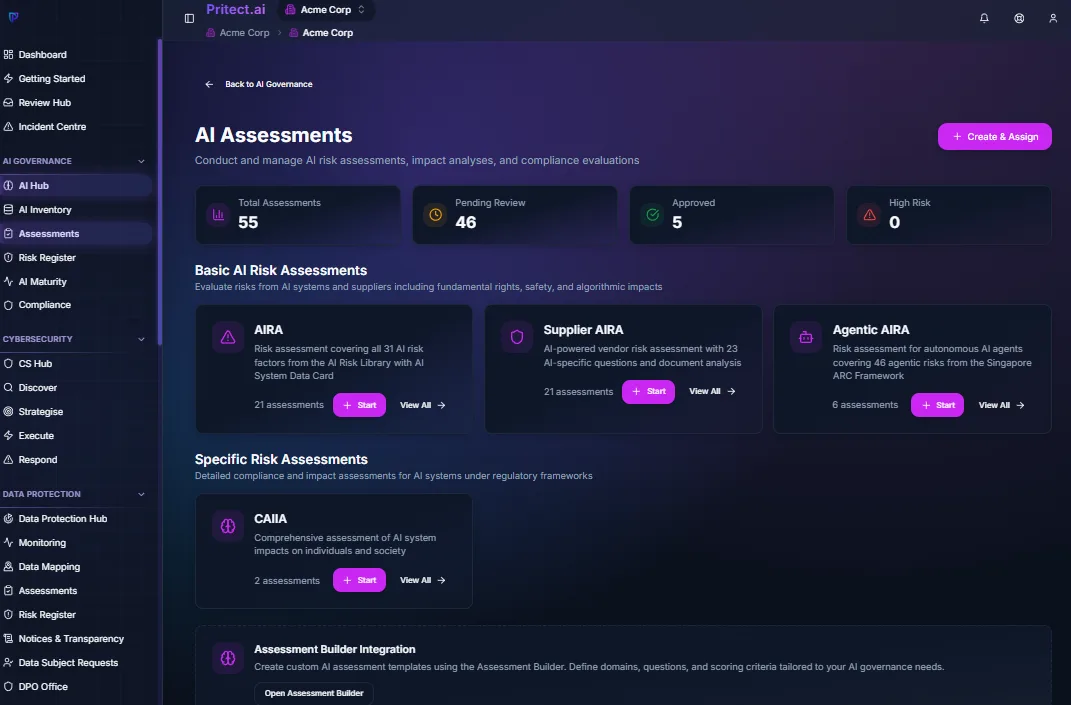
Assess
Evaluate AI risks systematically
Run structured assessments covering fundamental rights, ethical impacts, and regulatory compliance.
- AI Risk Assessment (AIRA)
- Supplier AI Risk Assessment (Supplier AIRA)
- Agentic AI Risk Assessment (Agentic AIRA)
- Comprehensive AI Impact Assessments (CAIIA)
- Fundamental Rights Impact Assessment (FRIA)
Govern
Establish accountability
Define ownership, set maturity targets, and track AI governance program effectiveness.
- Maturity Assessments
- Shadow AI Management
- AI Relationship Network
- Policy Management
Respond
Manage AI incidents
Handle AI-related incidents with structured workflows and maintain full audit trails.
- AI Incident Management
- Regulatory Notifications
- Remediation Tracking
- Audit Trail & Version History
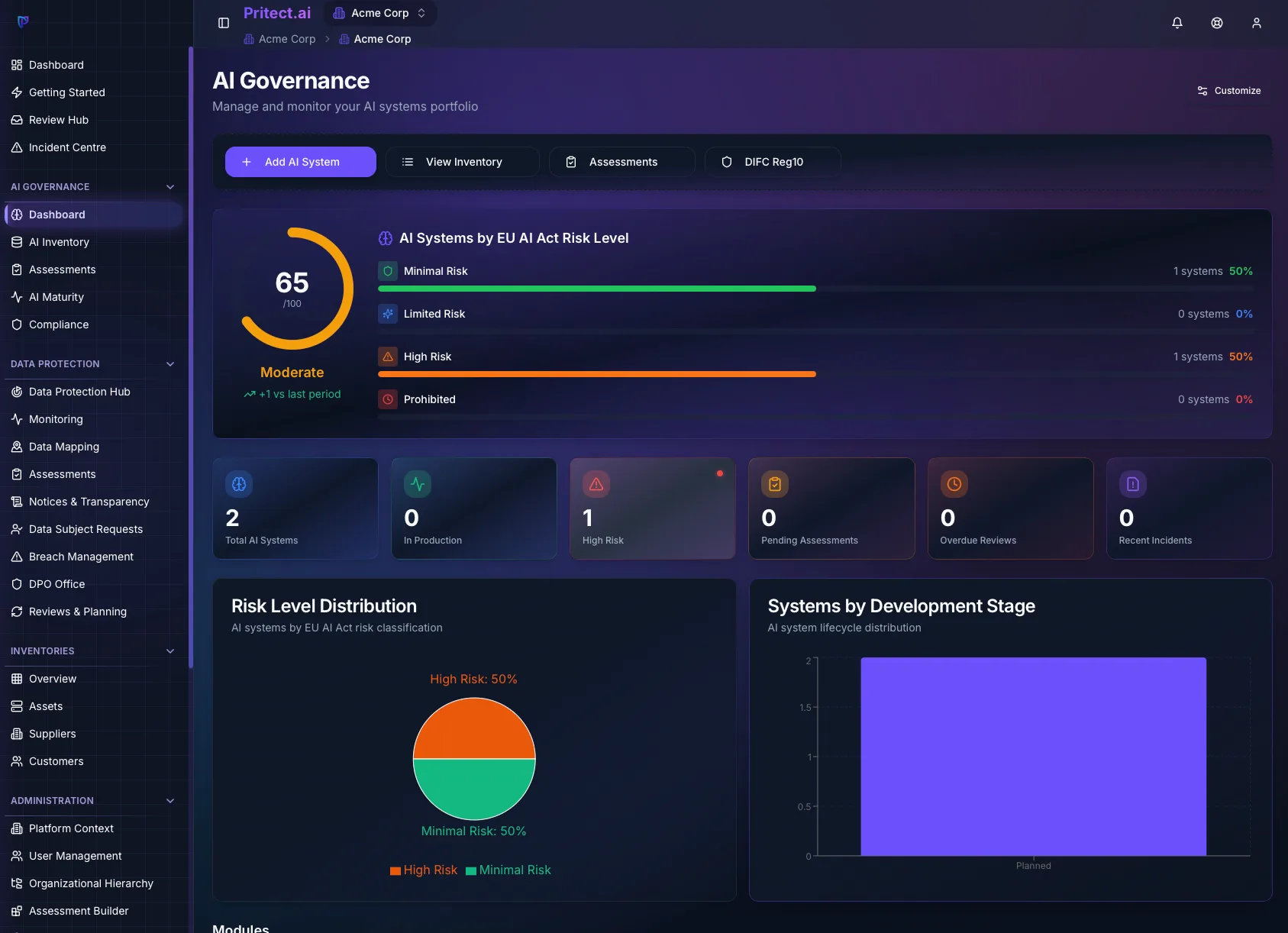
EU AI Act Risk Classification
Automatically categorise your AI systems according to EU AI Act risk tiers and apply appropriate governance measures.
Minimal
No specific requirements
Examples: Spam filters, AI-enabled video games
Limited
Transparency obligations
Examples: Chatbots, emotion recognition
High
Strict compliance requirements
Examples: Recruitment tools, credit scoring, biometric ID
Unacceptable
Prohibited under EU AI Act
Examples: Social scoring, real-time biometric surveillance
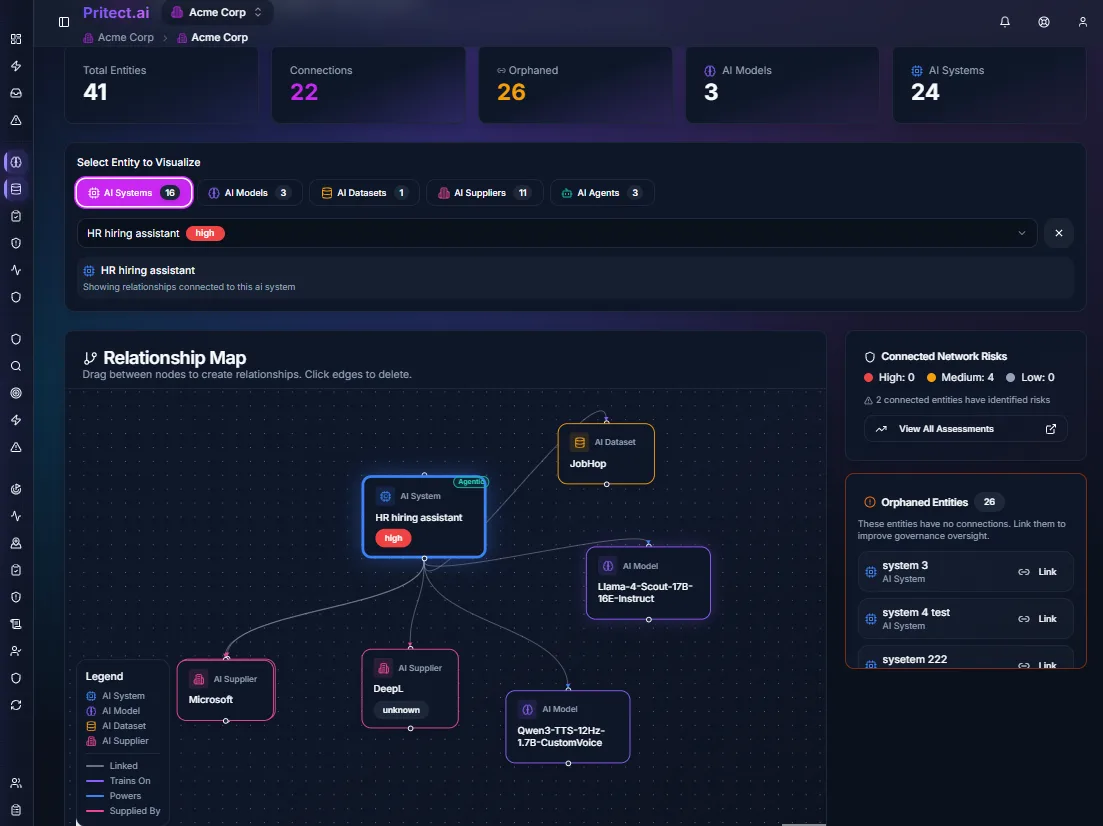
AI System Relationships
Visualise the interconnections between AI systems, models, datasets, and suppliers with our network mapping tool.
- Map dependencies between AI models and systems
- Track which datasets train which models
- Identify supplier relationships and supply chains
- Understand data flows across your AI portfolio
- Spot orphaned assets and governance gaps
Comprehensive Assessment Framework
Run structured assessments tailored to AI systems, from impact analysis to regulatory conformity.
CAIIA
Comprehensive AI Impact Assessment
Evaluate the broader impacts of AI systems on individuals and society
FRIA
Fundamental Rights Impact Assessment
Assess impacts on fundamental rights as required by EU AI Act
AI Act CA
EU AI Act Conformity Assessment
Ensure high-risk AI systems meet regulatory requirements
Ethics
AI Ethics Assessment
Evaluate AI systems against ethical principles and guidelines
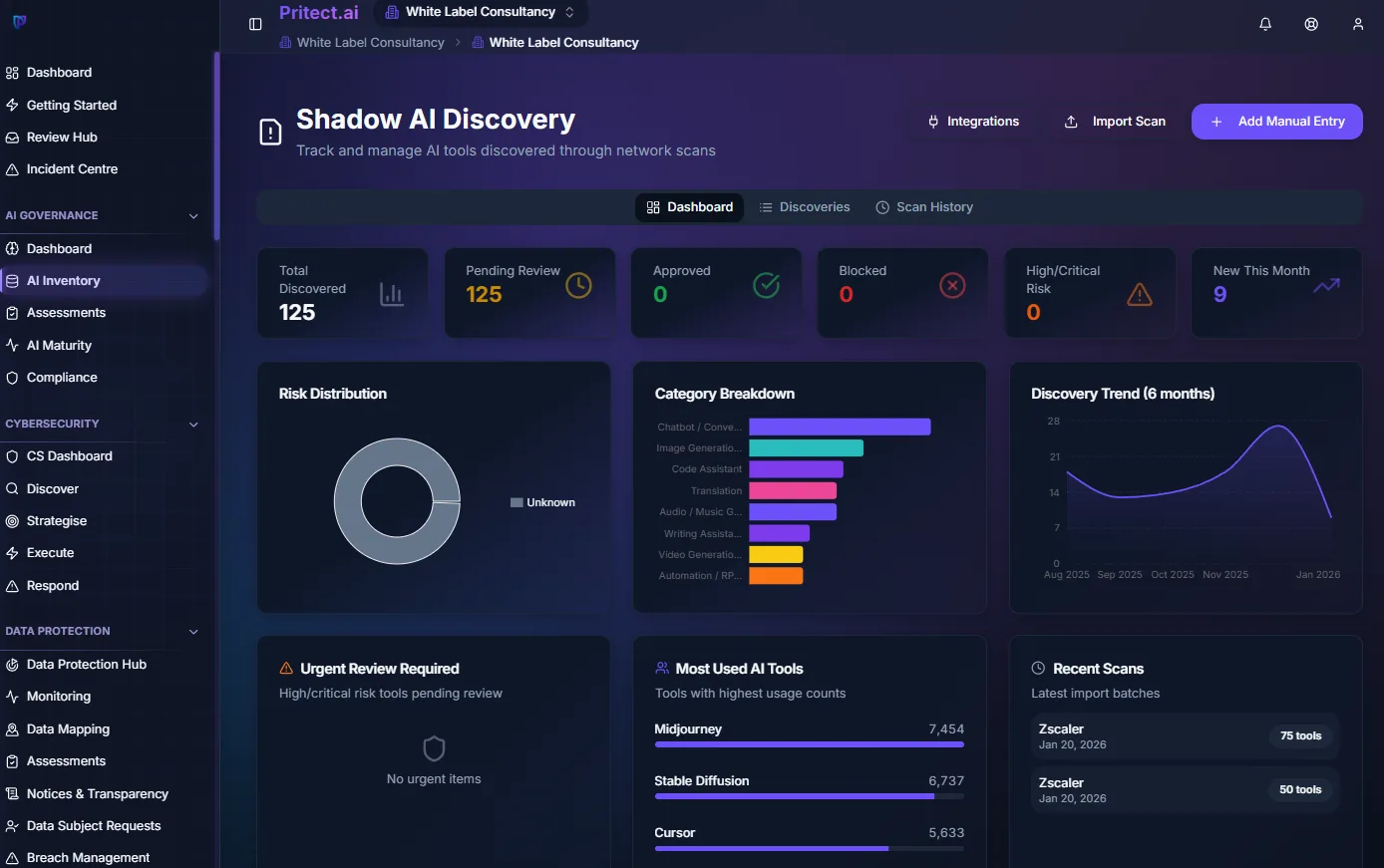
Shadow AI Management
Identify and govern unsanctioned AI tools being used across your organisation. Bring shadow AI into the light with automated discovery and risk assessment.
- Import AI tools discovered from network scanning
- Risk classification for discovered tools
- Workflow to review, approve, or block tools
- Promote approved tools to your official inventory
- Track adoption trends across departments
Enterprise-Ready Capabilities
Built for complex organisations with multi-entity structures and rigorous compliance requirements.
Multi-Entity Support
Manage AI governance across complex corporate structures with cascading policies and entity-specific configurations.
EU AI Act Alignment
Built-in support for EU AI Act risk classification, conformity assessments, and regulatory reporting requirements.
AI Supplier Governance
Track third-party AI services with due diligence workflows, contract monitoring, and risk assessments.
Shadow AI Management
Discover and govern unsanctioned AI tools across your organisation to maintain compliance and control.
Ready to Govern AI with Confidence?
Join organisations building responsible AI practices. Start your AI governance journey today.
From the resource library
Related guides and analysis
- Perspective
Sequence before software: how legal and compliance functions actually become AI-enabled
Most functions buy the tool first, and then spend a year discovering that the tool was never the constraint. The order that works is candidates, then process, then software.
9 min read - Whitepaper
Managing AI Risks: Inventory, Assessments and Evaluations
Three pillars make an AI governance programme defensible, the AI inventory that indexes every system, structured assessments that judge what could go wrong, and empirical evaluations that test how the system actually behaves.
3 min read - Checklist
EU AI Act readiness checklist
A pragmatic checklist for getting ready for the EU AI Act, from building an AI system inventory to classifying risk, assigning obligations, and connecting them to your existing governance.
7 min read